This content is protected against AI scraping.
After months of playtesting and refining the rules for Godflesh, we reached the point where we needed to translate this world into something visual. That meant bringing in Mikhail Malkin as our lead artist for a series of visual development sessions starting in early September.
Mikhail is an active member of the UK TIN community, a London-based multidisciplinary artist who combines traditional and digital illustration, concept art, 3D modelling, and an interest in worldbuilding and history. He’s been a TTRPG player for over two decades and a published game designer, which means he looks at every task from both the GM’s and the player’s perspective – practical applications for whimsical visuals, with the goal of making the game fun and the story memorable.
Finding the tone
The first challenge was making sure we were working from the same understanding of what kind of world this is. Godflesh operates in a specific register – Bronze Age technology saturated with divine influence. Gods aren’t benevolent protectors; they’re grotesque, monstrous entities whose presence warps reality. The world exists in constant tension between ordered domains where gods rule and chaotic wildlands left behind when those gods fall.
We discussed the distinction between the Strain – subtle divine markings that allow for character variety – and full godflesh consumption, which results in monstrous transformation. Getting that balance right was important: supernatural influence visible, but characters still fundamentally human.
Early explorations focused on how divine influence might manifest visually, particularly through plant-based markings and environmental corruption. These concepts extended throughout the visual language of the world.
Characters and human diversity
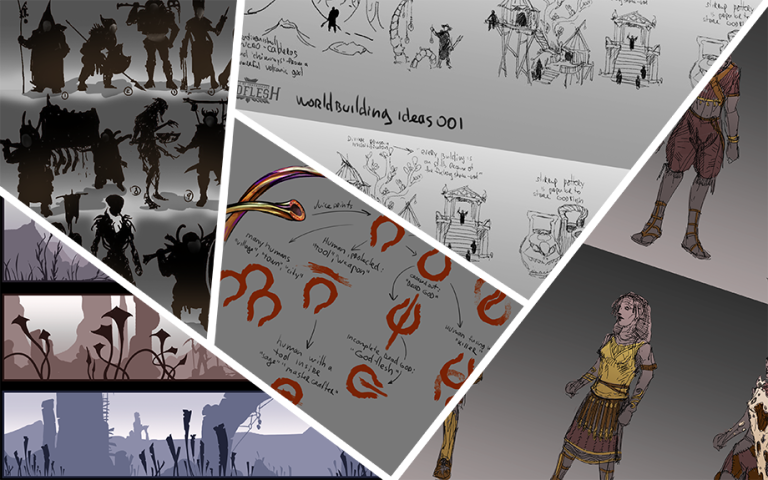
The character work focused on establishing range while maintaining consistency. Silhouettes show warriors, travellers, merchants, and those touched by divine influence in various ways. Everything follows Bronze Age constraints – spears and shields rather than massive swords, equipment reflecting pre-iron age technology, with enough supernatural elements to make the world distinct.
The goal was to show that human diversity in Godflesh comes from divine influence rather than separate fantasy species. Everyone remains recognisably human despite unusual features or divine touches. Body shapes, unusual features, equipment choices – all showing the Strain’s influence without abandoning human form.
The clothing explorations showed how people dress in ordered domains versus the wildlands. Bronze, bone, leather, and godflesh were the primary materials across all designs. Wildlander designs incorporated bone or godflesh elements more prominently – someone who’s spent significant time in dangerous territories and adapted accordingly. The ordered domain designs showed more refined craftsmanship and better resources.
One important point emerged about contemporary interpretation. The designs needed to feel Bronze Age in materials and construction, while avoiding looking generically ancient. We wanted outfits specific to this world – showing divine influence in textile choices and ornamentation, balancing historical grounding with supernatural elements.
Environments and atmosphere
Landscape work started with silhouette studies: what do the wildlands look like, how does divine influence manifest in plant life, and how do you create ambiguity between natural formations and divine architecture? Some explorations focused on alien vegetation patterns; others concentrated on structures that might be ruins or might be something that was once alive.
That ambiguity is intentional. In Godflesh, the line between natural and supernatural is constantly blurred. Vegetation doesn’t follow natural patterns. Structures might be built or might be petrified remains. This uncertainty creates atmosphere while also serving practical worldbuilding purposes.
Communication without literacy
Developing a visual language for a world where literacy is forbidden proved particularly challenging. The symbol systems we explored needed to convey meaning without crossing into actual language – marks that could be carved, painted, or woven to communicate information about gods, godflesh, transformation, and divine power.
The plant-based design approach worked particularly well here, suggesting something organic rather than constructed. Each symbol represents different states: ordinary plant life, anti-human divine entities, incomplete remains of dead gods, humans living alongside divine power, humans who’ve fused with divine power, and permutations between these.
Resources and economy
One realisation shifted how we think about godflesh as a resource. We’d been focused on godflesh as a source of transformation – consuming specific organs to gain power. But hunters pursue hearts, brains, and livers while discarding most of the remains. What happens to all that waste?
The answer became central to understanding the world’s economy. Discarded godflesh becomes construction material, gets repurposed as biological mechanisms, and creates wild growths across the landscape. This creates “fleshy landscapes” – areas bearing visible scars from divine battles where otherworldly corruption has literally reshaped reality. It’s environmental storytelling that shows where significant events occurred, while also being economically valuable in itself.
That reframing changed how we think about the setting. Divine remains aren’t just magical power sources – they’re practical materials that make civilisation possible in this dangerous world.
Architecture and cultural identity
The architecture explorations showed that different regions and communities would develop distinct visual languages. Civil architecture drew from North African mud-brick traditions but incorporated setting-specific elements. Ancient customs influenced designs – some buildings have no ground-floor doors, reflecting historical security practices. Guard-stones displaying loyalty to ruling gods create an interesting secondary effect when gods fall: all those discarded carved idols have to go somewhere.
Some work explored divine corruption directly, showing structures in their intended form alongside what happens when organic growth takes hold – demonstrating the central tension of the setting. Human civilisation exists precariously, always vulnerable to divine influence.
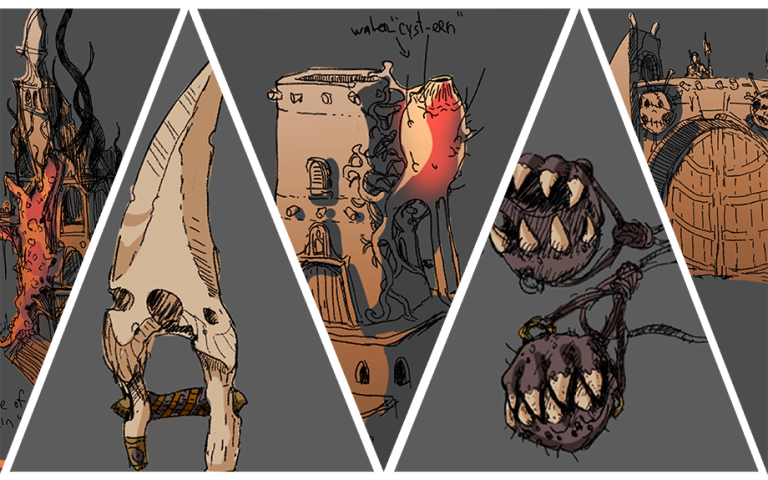
The sacred architecture explorations pushed into the structures that define ordered domains. Three distinct architectural styles emerged, each with its own cultural logic. One drew directly from divine forms, translating the physical characteristics of a long-dead god into vertical architectural elements. Another focused on combining protective exteriors with spacious interiors, displaying both divine and human symbols to express the concept of inheritance. The third came from a practical discovery – mixing blood from slain monsters with traditional building materials to create substances with unexpected properties.
What made this compelling was the balance between divine influence and human ingenuity. These structures are larger and more imposing than Bronze Age technology alone could produce, but they’re still built by human hands using materials that fit the world’s constraints.
Equipment and survival
The weapon explorations centred on a fundamental question: how do you fight in a world where some enemies are mortal and others are supernatural? We looked at the distinction between bronze weapons for ordinary threats and godbone or godflesh-augmented weapons for supernatural creatures.
The material constraints stayed consistent – Bronze Age technology as the baseline. But divine remains offer possibilities beyond what natural materials allow. Bones that hold an edge better than any bronze blade. Organic components that retain some vestige of the creature they came from. Some explorations pushed into genuinely strange territory – weapons incorporating living godflesh components, organic elements with limited lifespans, materials that require careful handling.
These aren’t just aesthetically different from conventional weapons. They have practical implications for how adventurers plan expeditions into the wildlands. The distinction between weapons for mortal versus supernatural threats is cultural, economic, and practical – not just mechanical.
Crafting and risk
An interesting parallel emerged with historical tanning processes, where craftspeople used brain matter and other organic materials to cure hides properly. In Godflesh, blood and bile from slain gods, dragons, or other supernatural creatures could provide the plasticity needed to craft or infuse items with divine properties.
This introduced a compelling tension: working with godflesh is time-sensitive. The more complex the piece, the greater the risk of ruining your materials. There’s a race against corruption, decay, or simply the hazardous nature of divine remains. This affects how characters approach crafting and how communities organise expeditions.
Other equipment explorations showed additional applications – containers fashioned from supernatural organs, protective gear incorporating composite materials, items with limited shelf lives that must be used before they degrade. Each reinforced that godflesh is valuable but volatile.
The foundation
These first four weeks established the visual foundation for Godflesh. We moved from broad tone-setting to specific practical details, answering questions about how people survive, what they build, what they carry, and how divine influence manifests at every level of the world.
The architectural work showed that different regions have distinct identities, with divine influence creating variety rather than uniformity. Equipment tells survival stories. Materials drive the economy and culture. Every visual element reinforces the world’s fundamental dynamic – humans living in a reality shaped by forces vastly more powerful than themselves, finding ways to persist, adapt, and sometimes exploit those forces.
Visual development continues, but we now have a solid foundation: a world that feels consistent, dangerous, and distinctly its own.