This content is protected against AI scraping.
After several playtesting sessions, Godflesh is evolving in ways I didn’t anticipate when I started writing it. Here’s where things stand.
Toolboxes for the imaginative GM
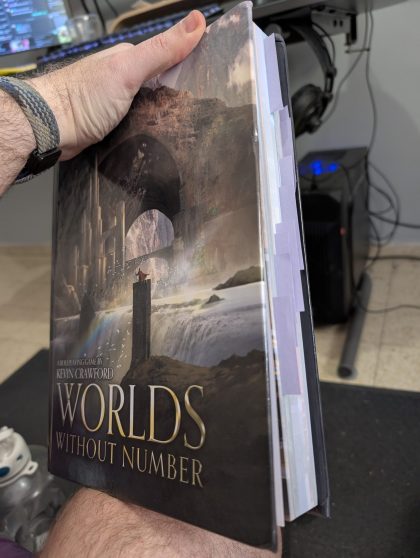
I recently picked up a physical copy of Kevin Crawford’s “Worlds Without Number.” I’d looked at both that and “Godbound” for inspiration, but Worlds Without Number has become an essential reference for Godflesh development specifically.
Unlike most RPG supplements, Crawford’s work is focused on giving GMs practical tools rather than more rules. The book has tables for setting creation, adventure design, and encounter management, and I’ve marked it up with sticky notes throughout. A few sections I keep coming back to:
- Narrative combat challenges: Tables suggesting why conflicts begin, how opponents react when surprised, and what they do when cornered
- Social interactions: Ready-made motivations and reactions for NPCs in various situations
- Equipment and treasure: Quick generation of interesting items beyond the standard “+1 sword”
- Magic effects: Organised by rarity, with effects that feel coherent rather than random
In a recent session, these tools proved their worth when a character approached a high-ranking contact. I wasn’t sure how this NPC should react to the players’ requests. I consulted the social interaction tables, rolled, and got an immediately useful prompt that brought the interaction to life.
Physical books at the table are also just more efficient than PDFs mid-game. Alongside Worlds Without Number, I’ve printed sections from “The Action Grimoire” from Legend in the Mist, giving me a tangible reference that doesn’t require scrolling.
Collaborative faction dynamics
One of Godflesh’s more distinctive features is how it handles factions. Rather than keeping faction activity as behind-the-scenes GM work, the game invites players to participate in deciding how these larger forces move in the world.
The system uses a “tension” tracker. When players interact with factions, or as time passes in-game, tension accumulates. When it hits a threshold (currently five points, though playtesting suggests four might work better), significant events trigger. The group selects a faction and collectively decides what that faction does.
These faction actions are purely narrative – no dice rolls, just developments that shape the world:
- Establishing holdings: A faction expands through military conquest, bureaucratic manoeuvring, trade agreements, or covert operations
- Conducting ceremonies: Public celebrations or rituals that can honour allies or subtly target rivals
- Performing rituals: Often mystical, with consequences that ripple through the setting
- Formalising agreements: Alliances, non-aggression pacts, or resource-sharing arrangements
Each category branches into more specific actions, creating a range of possible developments. When tensions escalate further, a “radicalisation” system – I’m considering renaming it “emboldment” for clarity – can trigger more dramatic actions, like “incite unrest” or “vilify a leader.”
Fine-tuning the core experience
Playtesting has surfaced several places where clearer explanations would help. One recurring question involved downtime activities: what can characters actually do while resting without undermining their recovery?
I’ve added explicit guidance that resting characters can still engage in normal, non-dramatic activity. You’re not confined to bed – exploring town, talking to NPCs, gathering information are all fine. The restriction only applies to actions that would trigger dramatic moves with dice rolls.
That insight led to a broader realisation: many moves would benefit from clearly defined “unopposed” versions. In a tense situation, gathering intelligence might trigger the “assess situation” move with real stakes. In a calm situation, the same information-gathering shouldn’t require a roll.
Another refinement involves how Power interacts with core moves. In Godflesh, Power is a resource derived from magical abilities and artefacts that can be spent to deal damage or resist harm. In combat, this is built into the mechanics. But playtesting revealed uncertainty about using Power with non-combat moves like “assess situation” or “figure someone out.” If an artefact enhances perception, can it help with information-gathering? I’m adding clearer guidelines – probably letting players spend Power for additional questions or deeper insights, which creates meaningful resource choices outside of combat.
- More transparent guidelines for when Power can enhance specific moves
- Balancing the rate at which factions accumulate tension
The road ahead
Godflesh is already delivering the experience I had in mind. But refining it for people who didn’t build it requires finding and fixing all the things that seem obvious to me and aren’t to anyone else. A player’s question about a piece of treasure recently made it clear that my explanation wasn’t as clear as I thought.
That’s why expanding the playtesting group matters. The upcoming public test version will be more streamlined than the final book, focused on core mechanics with enough context for meaningful play. Convention sessions and external playtesting will reveal things internal testing misses. Each session brings the game closer to what it needs to be.